
What Probate Covers in Clay County
Probate is the legal process of settling what a person owns and owes after they die. It proves a will, names someone to manage the estate, pays valid debts, and passes property to heirs. In Mississippi the job does not fall to a separate probate court. It belongs to the Chancery Court, the court of equity that handles family and property matters. Clay County probate records are built and stored there.
The Chancery Court does more than wills and estates. Its judges hear guardianships for minors, conservatorships for adults who cannot manage their own affairs, and sanity hearings. They also handle divorce, custody, adoption, and disputes over land titles. Many of those land disputes grow out of an estate, so probate and real-property records often cross paths in the same court.
Because of this split, a probate file is a Chancery Court case file. The Chancery Clerk keeps the original papers and helps the public find them. Knowing that probate equals Chancery Court is the single most useful fact for anyone starting a search in Clay County.
Probate Terms Defined
Probate filings use words that rarely show up in daily life. A few quick definitions make a Clay County estate file much easier to read.
- Testator
- The person who made the will. A will speaks for the testator after death.
- Executor
- The person named in the will to carry out its terms and settle the estate.
- Intestate
- Dying without a valid will. State law then decides who inherits.
- Guardianship
- A court arrangement that gives an adult legal authority over a minor or that minor's affairs.
- Conservatorship
- A court arrangement that puts an adult's finances or care under a named conservator when the person cannot manage alone.
How to Search Clay County Probate Records
There is no single public website that returns full Clay County probate files by name. Access runs through a few channels instead. The Chancery Clerk's counter holds the paper record. Mississippi Electronic Courts (MEC) holds electronic case files for courts that use it, and the Chancery Court has adopted MEC. A phone call often settles which path is faster for a given estate.
Start with the court and clerk, then pick a channel. The steps below follow the route Clay County describes for its Chancery filings.
- Confirm the matter is a Chancery Court case, since wills, estates, guardianships, and conservatorships all route there.
- Try Mississippi Electronic Courts for electronic case files, using the court, a party name, or a case number where the portal exposes those filters after login.
- If the file is older, sealed, or not in MEC, contact the Chancery Clerk at 365 Court Street to check the paper record.
- For court dates and docket timing, call 662-494-3124 and ask for Vicki Ray.
- Request certified copies of a will, an order, or letters of appointment from the Chancery Clerk once you find the file.
Note: MEC may require registration or login, and document viewing can carry fees, so free public access is not guaranteed for every Chancery filing.
Clay County Probate Court Contacts
Probate runs through the Clay County Chancery Court, and the Chancery Clerk is the office that takes filings and pulls records for the public. The court page lays out its jurisdiction and docket contact, while the clerk page lists the staff who actually handle the files. The Chancery Court page is shown below.
The Clay County Chancery Court page describes the court's authority over wills, guardianships, sanity hearings, and land disputes.
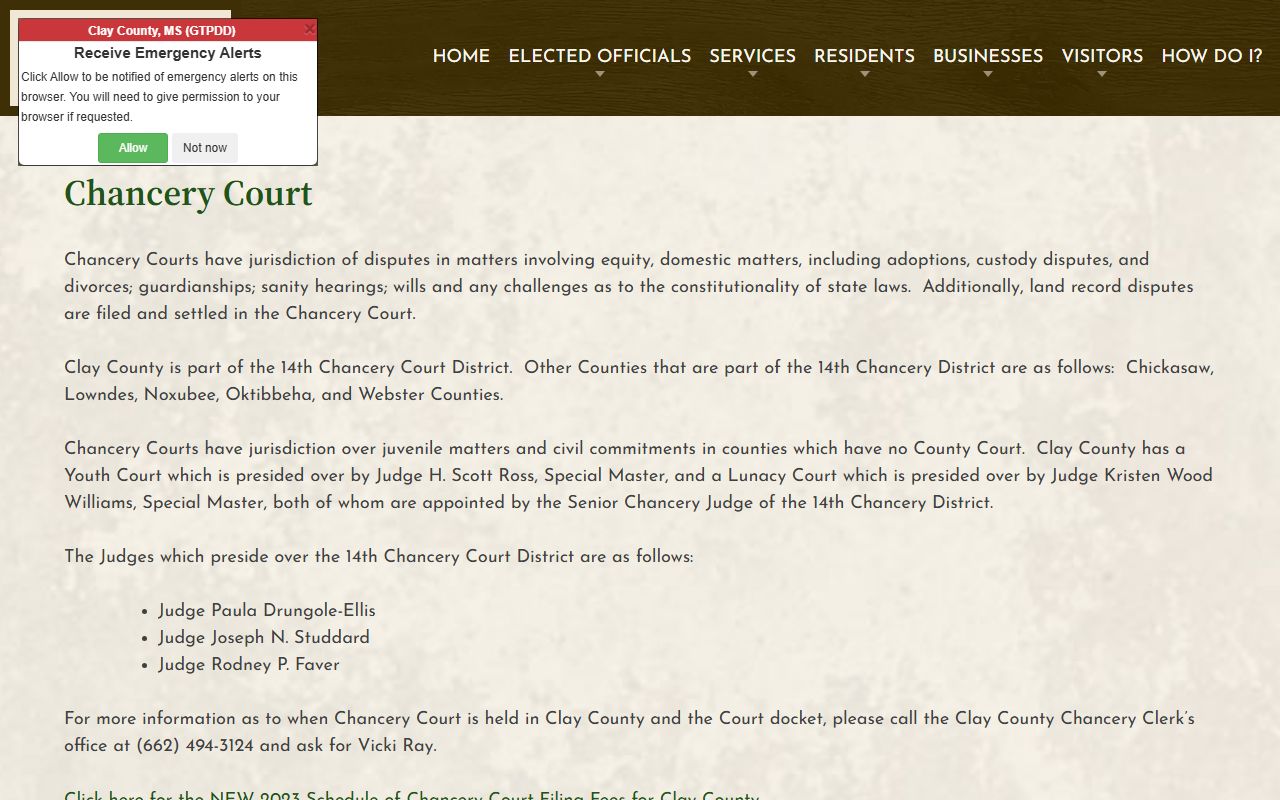
It also names the docket contact and the judges who sit in the district, which helps when you need a hearing date rather than a copy.
Clay County Chancery Court
365 Court Street
West Point, MS 39773
662-494-3124
Docket info: ask for Vicki Ray
Clay County Chancery Clerk
LaFrance H. Boyd, Chancery Clerk
365 Court Street (P.O. Box 815)
West Point, MS 39773
662-494-3124
Court records: April Edwards
Hours: 8:00 a.m. to 5:00 p.m., Mon to Fri
The clerk's office is the place to confirm fees, mail-copy rules, and which filings are open before you travel. The office details for the Chancery Clerk are pictured next.
The Chancery Clerk office information page lists the clerk, the address, and the staff assigned to court records.
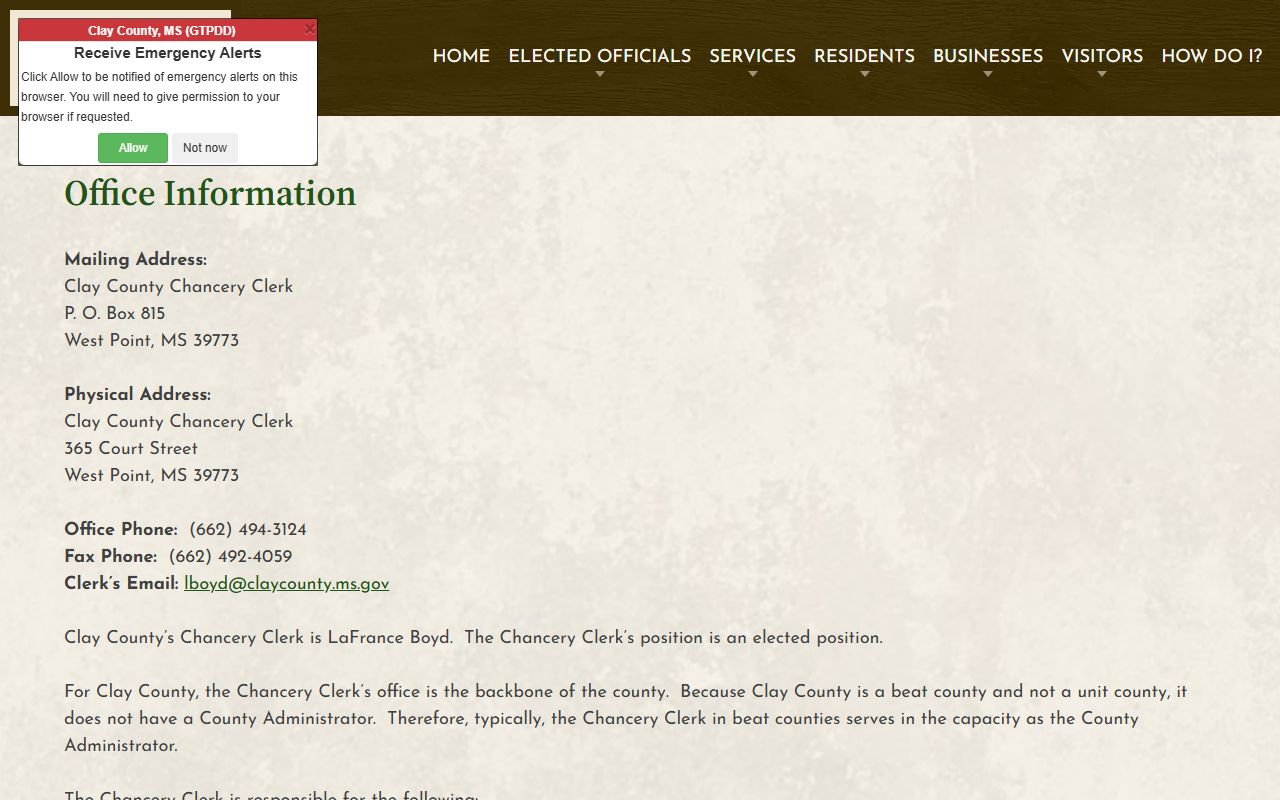
April Edwards is listed for court records, so she is a useful name to ask for when requesting a probate file or a certified copy.
The 14th Chancery District
Clay County does not have its own standalone Chancery bench. It sits inside the 14th Chancery Court District, a six-county district that shares its judges. The other counties are Chickasaw, Lowndes, Noxubee, Oktibbeha, and Webster. The judges rotate among them, so a Chancellor who hears a Clay County estate may sit elsewhere in the district on another day.
Three Chancellors serve the district: Paula Drungole-Ellis, Joseph N. Studdard, and Rodney P. Faver. One of them signs the orders that move an estate forward, from appointing an executor to approving a final distribution. Because the bench is shared, court dates in Clay County follow a rotating schedule rather than a fixed daily calendar.
Note: For the days Chancery Court actually sits in Clay County, call the Chancery Clerk at 662-494-3124 and ask for Vicki Ray rather than guessing from a general calendar.
Clay County Probate Filing Fees
Probate costs in Clay County split into two parts. There is the fee to open and process the case in Chancery Court, and there are copy fees for pulling documents out later. The county links a Chancery Court filing-fee schedule, but the exact line-item probate amounts were not posted in plain text, so confirm the current figure with the clerk before you file.
The copy fees below come from the Chancery Clerk's land-record rules. They apply to documents the office reproduces, including estate-connected land papers, and they give a fair guide to what a page costs at the counter.
| Item | Amount |
|---|---|
| Chancery probate filing fee | Confirm with clerk |
| Copy made by the public | $0.25 per page |
| Copy made by clerk staff | $0.50 per page |
| Certified copy | Additional fee (amount not posted) |
| Delta land-record document | $0.50 per page |
Payment at the Chancery Clerk is by cash or by check or money order made out to the Clay County Chancery Clerk. Mail requests for recorded land documents need the book and page number, payment, and a stamped self-addressed envelope.
What Clay County Probate Records Show
A probate file grows as the estate moves through the court. Early papers prove the will or open an intestate estate. Later papers track the money, the property, and the people who inherit. Read together, they show how an estate was settled from start to finish.
- Wills offered for probate and orders admitting them.
- Estate administration filings and letters naming an executor or administrator.
- Guardianship and conservatorship petitions and orders.
- Inventories, accountings, and creditor notices.
- Contested will filings and orders approving final distribution.
Estates that include real property can spill into land records. When an estate's title is disputed or a deed must be traced, the Delta Computer Systems land-record search for Clay County is a useful companion. It covers deeds from 2007 forward and deeds of trust from 2011 forward, and it is informational only, not a substitute for the official records at the courthouse. The same clerk who handles probate also keeps those land records.
Other Mississippi Record Offices
Settling an estate sometimes sends families to state offices that have nothing to do with Chancery Court. A vehicle in the estate may need a title transfer, and a driving record is occasionally requested when a death involves a crash. Those driver records are a separate state function, handled by the Mississippi Department of Public Safety, not by the Chancery Clerk who keeps probate files.
The Mississippi DPS Driver Records Division page explains how driving records are requested and where they are mailed.
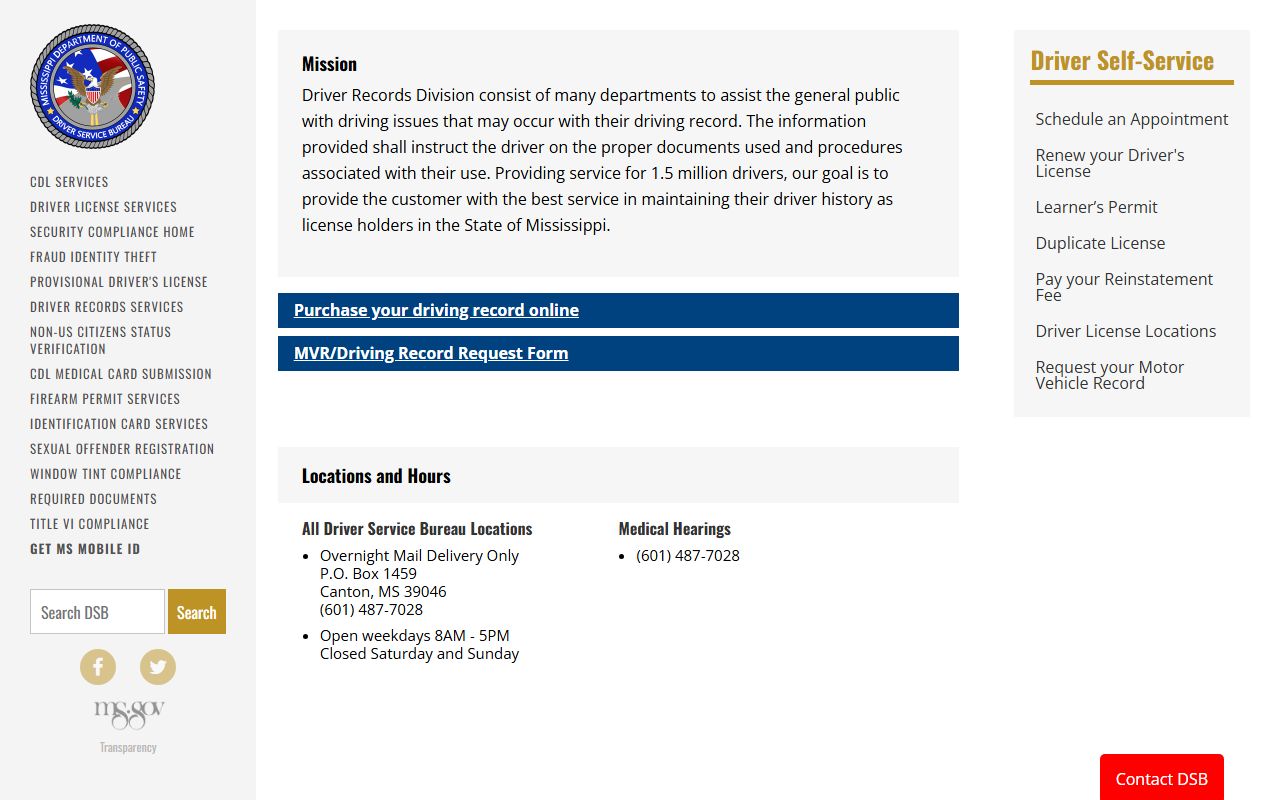
This office is included only to draw a clear line. A driving record is not a probate document, and a request for one does not go to the Chancery Court. For wills, estates, and guardianships, the Chancery Clerk remains the right office. Related marriage and divorce papers tied to an estate sit with the county's marriage and divorce records instead.
Restricted Clay County Probate Records
Not every probate-related file is open to the public. A standard estate file usually becomes public once it is filed, but several Chancery matters carry tighter rules. Guardianships and conservatorships often involve minors or vulnerable adults, so parts of those files may be shielded. Sanity and lunacy hearings hold confidential medical and personal detail, and Clay County uses a Lunacy Court special master for them.
Adoption files are not ordinary public records either. Access usually requires party status, an attorney, or a court order. Records that involve children, including Youth Court matters, follow juvenile-protection rules rather than open-docket access. Personal identifiers like Social Security and financial-account numbers may be redacted even on otherwise public papers.
Do not assume a guardianship, conservatorship, sanity, or minor-related file is open. Confirm access with the Chancery Clerk before traveling, since sealed material is withheld even when a related case is public.
When access is uncertain, the Chancery Clerk or the court decides. The office cannot give legal advice, but it can tell you whether a file is open, sealed, or limited. To request certified copies of any open record, the county clerk's office is the place to start.