
Criminal Court Records in Clay County
A criminal court record is the case file a court opens the moment formal charges are filed. In Clay County, the Circuit Clerk keeps the felony case files for Circuit Court. The Justice Court and the West Point Municipal Court keep their own misdemeanor files. The record grows as the case moves forward. Clerks add each indictment, motion, bond paper, order, and judgment to the file. By the time a case closes, the record shows the whole path from charge to sentence.
Clay County criminal cases split across court levels by how serious the offense is. Felonies route through Circuit Court in the Sixteenth Circuit District. A grand jury must indict before most felonies move ahead, and grand jury terms fall during the April and October court terms. Misdemeanors, traffic crimes, and early felony appearances often start in Justice Court or West Point Municipal Court. Each court holds the records for the cases it hears, so the place you search depends on the charge.
The county outlines its felony court terms and grand jury schedule on the Clay County Circuit Court page.
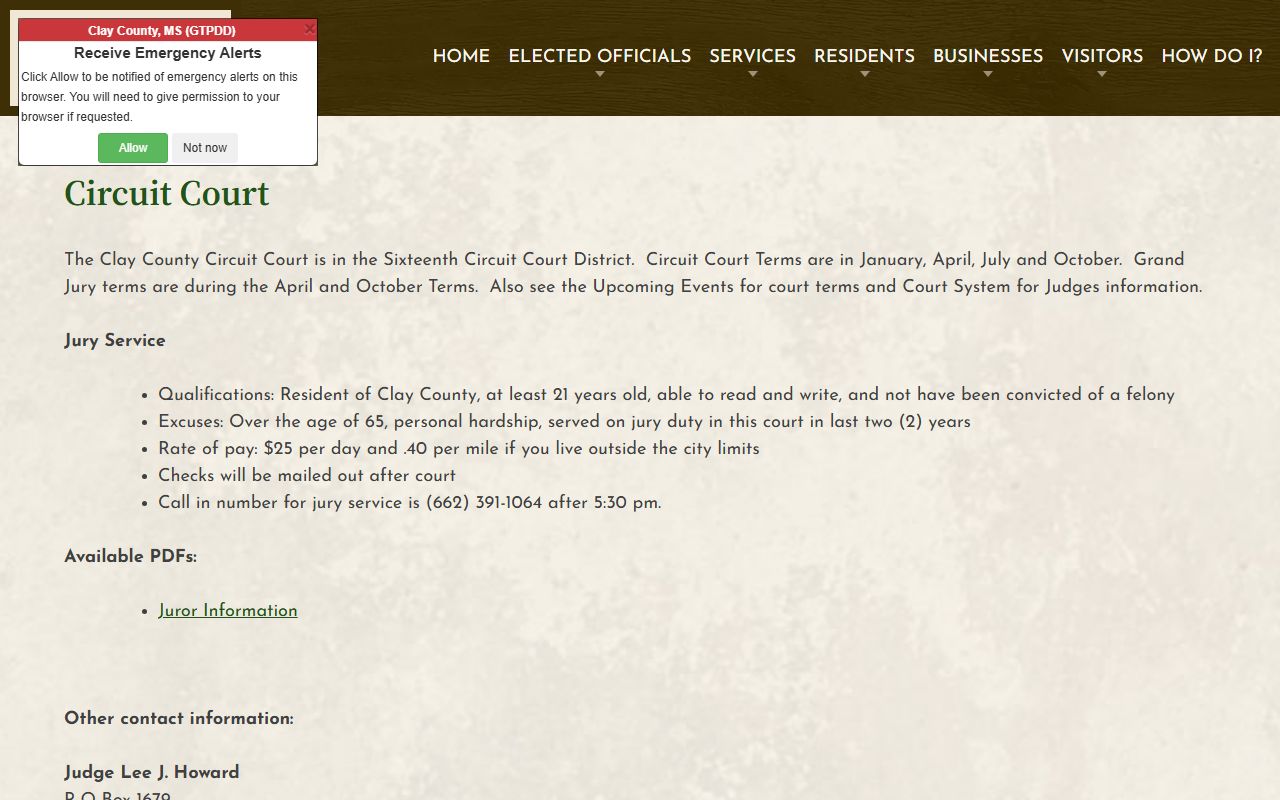
Circuit Court is the trial court that handles felony prosecutions and appeals from the lower courts. The same page lists the judges, court terms, and the offices that support each criminal case.
How to Search Clay County Criminal Court Records
Mississippi Electronic Courts, known as MEC, is the statewide portal for case and docket information in courts that use the system. The public can search and log in through the state portal, though full document access may require registration. For records that are not online, the Circuit Clerk holds the felony case files and can pull a case at the counter or by phone.
- Open the Mississippi Electronic Courts portal to begin a case search.
- Search by defendant name or by the assigned case number.
- Narrow the results by court, case type, and filing date.
- Open the case to read the docket entries and the disposition.
- Request a certified copy from the Circuit Clerk when you need an official record.
State-level criminal history is handled separately from court case files. The Mississippi Department of Public Safety runs the Criminal Information Center, which manages criminal history and related functions. Note that criminal-history records are not released through an ordinary public-records request, so a court case search and a full criminal-history check follow different paths.
The center is described on the Mississippi DPS Criminal Information Center page.
That state center supports criminal-information functions across Mississippi. It is a useful reference point when a county court file does not show the full picture.
Stages of a Clay County Criminal Case
A criminal case moves through a set order of steps, and each step adds entries to the record. The file opens when charges are filed. It then tracks every appearance, ruling, and motion until the court enters a final outcome. Reading the docket in order shows exactly where a case stands.
Case flow: Charges Filed › Arraignment › Pretrial / Motions › Plea or Trial › Disposition › Sentencing
| Stage | What Happens |
|---|---|
| Charges Filed | A complaint, information, or grand jury indictment opens the case and names the offense. |
| Arraignment | The defendant first appears in court, hears the charges read, and may enter a plea. |
| Pretrial / Motions | Lawyers file motions, set bond, exchange discovery, and argue legal issues before trial. |
| Plea or Trial | The defendant pleads guilty, or a judge or jury decides the case at trial. |
| Disposition | The court records the result: guilty, not guilty, dismissed, or otherwise resolved. |
| Sentencing | After a conviction or guilty plea, the judge orders the punishment and terms. |
What a Clay County Criminal Court Record Shows
A Circuit Court criminal file collects the documents and entries that define a case. It names the parties, lists each charge, and tracks the rulings that follow. The record also captures bond papers, subpoenas, jury matters, fines, court costs, and any appeal. Reading the fields together gives a clear picture of what happened and how it ended.
| Field | What It Shows |
|---|---|
| Case Number | The unique number the clerk assigns to track the case and its filings. |
| Court | The court that holds the case, such as Circuit, Justice, or Municipal Court. |
| Defendant | The name of the person charged, along with identifying case details. |
| Charges | The offense or offenses named in the indictment, information, or complaint. |
| Plea | The defendant's formal response, such as guilty, not guilty, or no contest. |
| Motions and Orders | Written requests by the lawyers and the judge's written directives. |
| Disposition | The final outcome, such as dismissed, acquitted, or convicted. |
| Sentence | The punishment ordered, such as jail time, probation, fines, or court costs. |
Charges vs. Convictions
Being charged is not the same as being convicted. A charge is only an accusation that a crime took place. A conviction is a finding or plea of guilt entered by the court. A criminal court record can show charges that were later dropped, dismissed, or ended in acquittal. Always read the disposition before assuming an outcome. For a closer look at how charges get filed, amended, or reduced, see the Clay County arrest records and court charges page.
| Charge | Conviction | |
|---|---|---|
| Stage | Accusation at the start of a case | Verdict or guilty plea |
| Burden of Proof | Probable cause | Beyond a reasonable doubt |
| Meaning | The state believes a crime occurred | The court found or accepted guilt |
| Public Record | Yes | Yes |
Reading Dispositions and Sentences
The disposition is the final result of a case. Common entries include guilty, not guilty, dismissed, and no contest, which the courts often call nolo contendere. Some cases end in a continuance, which means the court pushed a hearing to a later date. A dismissal or acquittal means there is no conviction on the record. A guilty finding or plea moves the case to sentencing.
A sentence sets the punishment after a conviction. It can include jail or prison time, fines, court costs, restitution, and probation. Probation is a supervised sentence served in the community rather than behind bars. In Clay County, the Mississippi Department of Corrections runs the local probation office that supervises many sentenced defendants. That supervision often appears in the file after sentencing and explains the terms a defendant must follow.
Who Prosecutes Clay County Criminal Cases
Two prosecutors handle most criminal matters in Clay County. Felony cases in Circuit Court are prosecuted by the District Attorney for the Sixteenth Circuit District, Scott Colom. His office takes felony charges to the grand jury and tries them in Circuit Court. Misdemeanors filed in Justice Court are handled by the County Prosecutor, Robin Brown, who also prosecutes appeals from Justice Court and preliminary hearings for felony charges.
The District Attorney's office serves the full Sixteenth Circuit District and posts its contact details online.
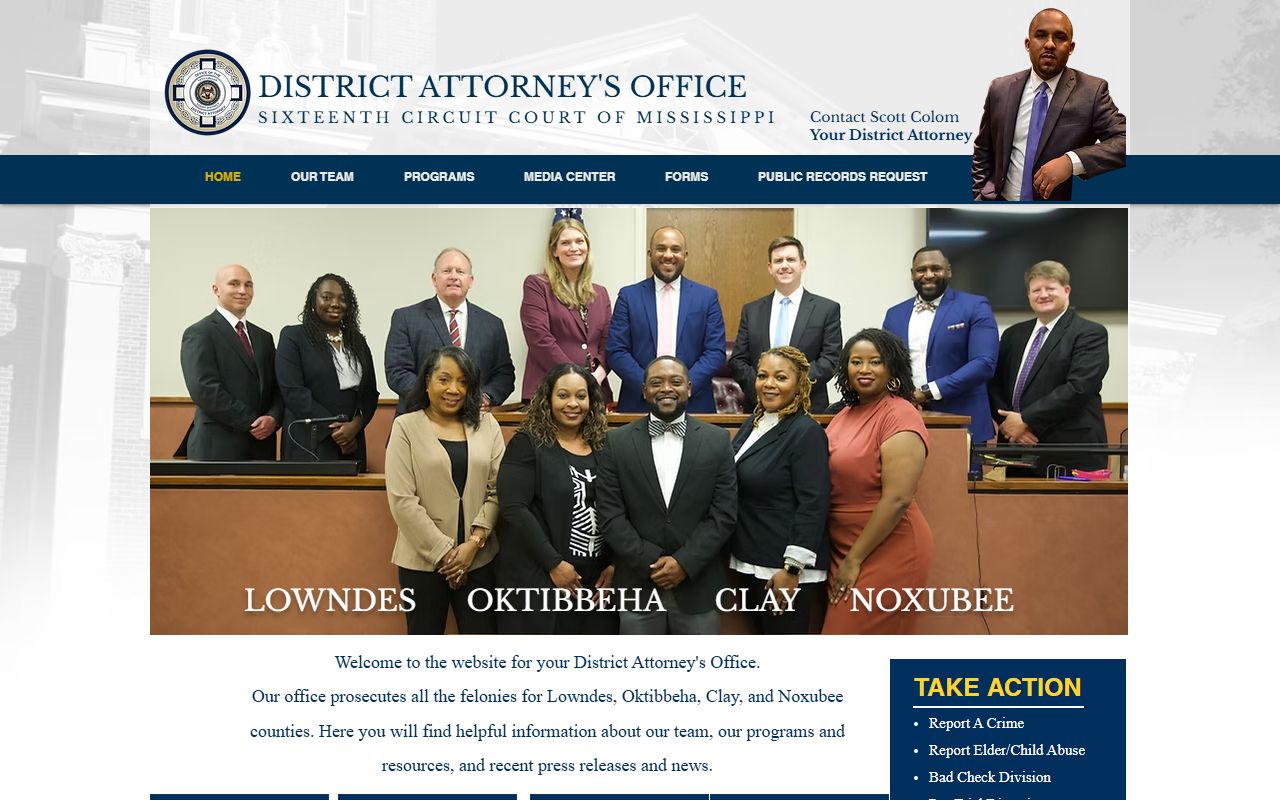
More about the office sits on the Sixteenth Circuit District Attorney site. Defendants who cannot afford a lawyer may be represented by the public defenders who serve Circuit Court, Kristen Wood Williams and Marlin Stewart. Their appointment and the lawyers on each side appear in the case file.
Federal Criminal Cases for Clay County
Some crimes are prosecuted in federal court rather than in Clay County Circuit Court. Clay County sits in the Northern District of Mississippi, with federal courthouses in Aberdeen, Oxford, and Greenville. Federal criminal cases cover offenses like narcotics trafficking, firearms violations, child exploitation, and public corruption. These files are kept in the federal system, not by the county clerk.
The U.S. Attorney represents the federal government and prosecutes federal crimes for the district.
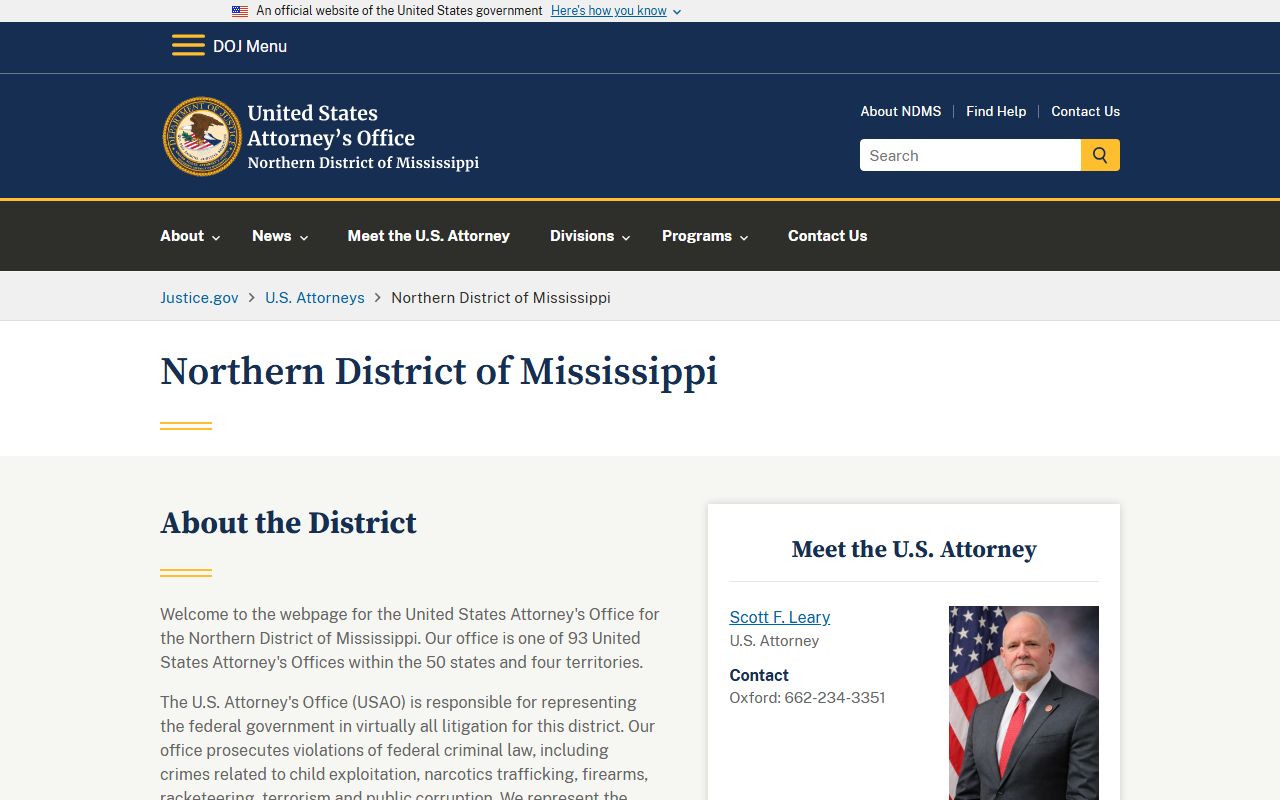
The role of the office is described on the U.S. Attorney for the Northern District of Mississippi page. The current interim U.S. Attorney is Scott F. Leary, who took the post in late 2025.
Details about the office's leadership are posted on its official bio page.
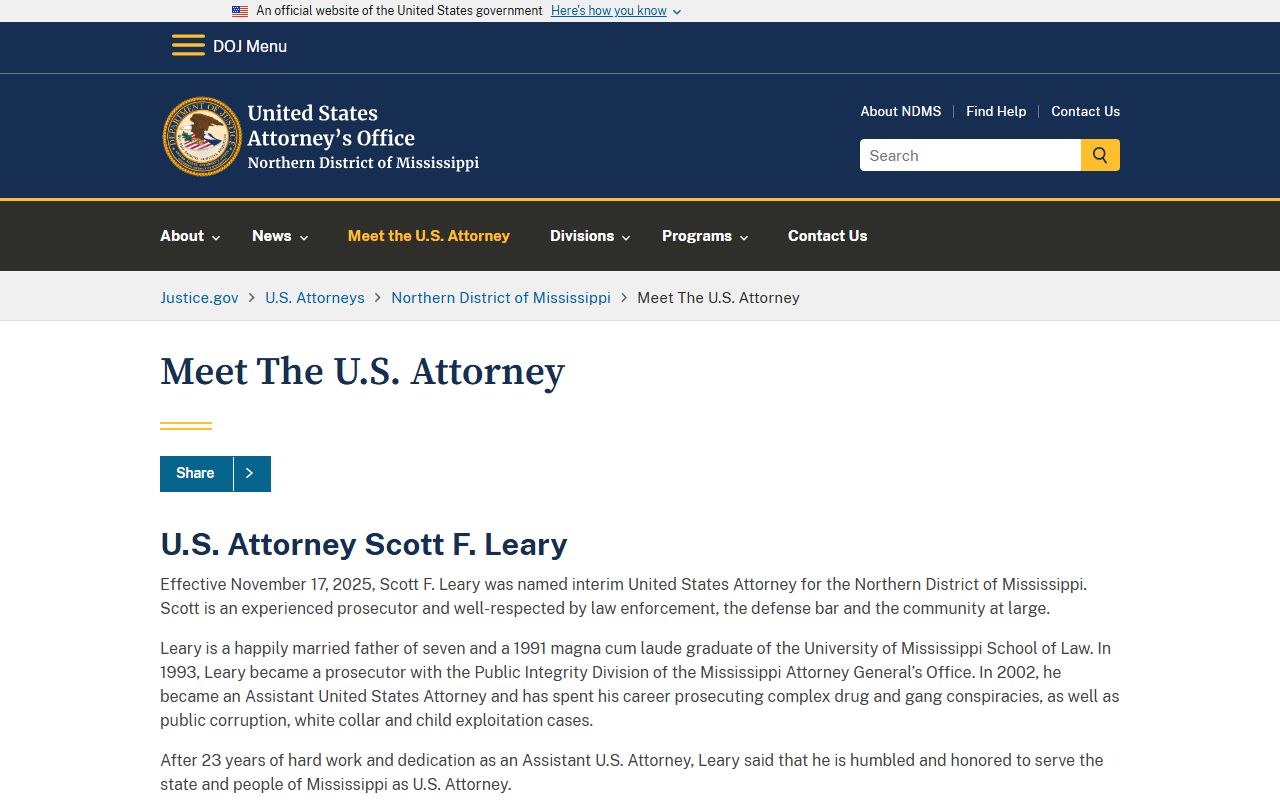
The Meet the U.S. Attorney page confirms the current appointment. Federal case files are searched through the PACER system, which is separate from the county and state court records.
Sealed vs. Expunged Records
Not every criminal record stays open to the public. Some are sealed, which hides them from ordinary view. Others are expunged, which removes them and treats the matter as if it never happened. Mississippi allows expungement under Miss. Code Ann. Section 99-19-71 for eligible arrests, dismissals, acquittals, and certain first convictions. A petition must be filed with the court that handled the case, and a judge must sign an order before any entry comes down.
| Sealed | Expunged | |
|---|---|---|
| Visibility | Hidden from public view | Removed and treated as never existing |
| Law Enforcement | Limited official access | Very limited access |
| Eligibility | Often juvenile or Youth Court matters | Eligible arrests, dismissals, acquittals, and certain first convictions |
Expungement is not instant once a judge signs the order. Court systems and outside agencies update their files on different timelines, so a record may linger in some databases for a while.
Public Access to Criminal Court Records
Mississippi treats most court records as open to the public. The Public Records Act lets anyone inspect public records unless a specific law exempts them. In practice, the path starts with the office that owns the record. Circuit criminal files go to the Circuit Clerk, while Justice Court and Municipal Court hold their own case records. A request should name an identifiable record rather than ask broadly for information.
Key Statutes:
Mississippi Code Ann. Title 25, Chapter 61 - Most public records are open for inspection unless a specific law exempts them.
Mississippi Code Ann. § 25-61-12(2) - Law-enforcement investigative reports may be withheld from ordinary public-records release.
Criminal discovery is not a public-records request. Under the Mississippi Rules of Criminal Procedure, discovery is sought through the prosecutor in the case, not from the clerk's public counter.
Background Check Considerations
A casual case lookup is not the same as a regulated background check. Reading a court file tells you what a record shows, but it is not a certified history for hiring or housing. Employers and landlords that screen applicants must use a process that follows the Fair Credit Reporting Act. A full criminal-history check runs through state channels, not through a quick name search.
Important: This website is not a consumer reporting agency under the Fair Credit Reporting Act, and its records cannot be used for credit, employment, tenant, or insurance decisions.
Restricted Clay County Criminal Court Records
Several types of criminal court records sit outside ordinary public access. Youth Court cases involving people under 18 are restricted to protect minors and families. Sealed and expunged matters are closed by court order. Records tied to an open investigation may be withheld while the case is active. The court can also redact sensitive details like Social Security numbers and medical information.
When a record is restricted, access usually requires party status, an attorney, or a court order. The clerk's office can confirm whether a file is open before you visit. For the broader set of filings beyond criminal matters, the Clay County court records overview points to each office that holds them.