
What Is a Clay County Court Docket
A docket is a running list of the events and filings in a case. Each line is a docket entry. It shows a date, what happened, and who acted. The clerk adds a new entry every time a paper is filed, a hearing is set, or a judge signs an order. Read together, the entries trace a case from its first filing to its final judgment. The docket is the timeline, not the paperwork itself.
That is the key difference from a full case file. The docket lists the motions, orders, and hearings. The case file holds the actual documents, exhibits, and signed orders behind each line. A docket entry might read "Motion to Continue Filed." The motion itself lives in the file. Many people only need the docket to learn a court date or check whether a ruling has been entered.
Clay County does not run one combined docket. Each court keeps its own. Felony and major civil matters sit on the Circuit Court docket. Divorce, custody, probate, and guardianship cases sit on the Chancery Court docket. Traffic, misdemeanor, and small civil cases move through Justice Court, while West Point handles its city cases in Municipal Court. Youth Court keeps a separate juvenile calendar under the Chancery structure.
How to Find Clay County Dockets Online
The main online channel is Mississippi Electronic Courts, the statewide filing and case-management system. Participating Circuit, Chancery, and County Courts maintain electronic case files in it. Clay County Chancery Court implemented the system effective November 1, 2013, by order of the senior chancellor. The general public-access information for the system states that one login reaches docket information, documents, and case details for courts that use it. Access may require registration, and viewing some documents may carry a fee.
The steps below outline a docket search through the state system. Have the court type and a party name or case number ready before starting.
- Open the Mississippi Electronic Courts portal and choose "Search for a Court and Login."
- Pick the court that holds the case. Circuit Court covers felony and major civil matters; Chancery Court covers divorce, probate, and guardianship.
- Enter a party name or case number, and add a filing date range to narrow a common name.
- Open the case and review its docket entries in date order, then download a listed document if access allows.
Not every case is online. Older files, sealed matters, juvenile cases, and records outside the electronic system will not appear. When that happens, call or visit the clerk that owns the file. For Circuit Court dockets, reach the Circuit Clerk at 662-494-3384. Land records sit in a separate Delta Computer Systems search and are informational only, not for closings or title work.
Note: Justice Court and Municipal Court cases may not appear in the same system as Circuit and Chancery dockets, so check those courts directly.
Courts That Hold Clay County Dockets
Five courts handle Clay County cases, and each keeps its own docket and contact point. Circuit Court and Chancery Court use the electronic system for many recent cases. The lower courts run their calendars on site, so a phone call is often the fastest way to confirm a court date. The list below shows where each docket lives.
- Circuit Court, in the Sixteenth Circuit District, hears felony, major civil, and lower-court appeals.
- Chancery Court, in the 14th Chancery District, hears divorce, custody, probate, guardianship, and land disputes.
- Justice Court hears traffic tickets, misdemeanors, small civil claims, and preliminary felony appearances.
- West Point Municipal Court hears city traffic, ordinance, and misdemeanor cases.
- Youth Court hears juvenile abuse, neglect, and delinquency matters under the Chancery structure.
Chancery Court docket timing is not posted as an online calendar. For court dates and docket information, the Chancery Court process is to call the Chancery Clerk at 662-494-3124 and ask for Vicki Ray. The image below shows the state overview of Chancery jurisdiction over equity, domestic, probate, and guardianship matters.
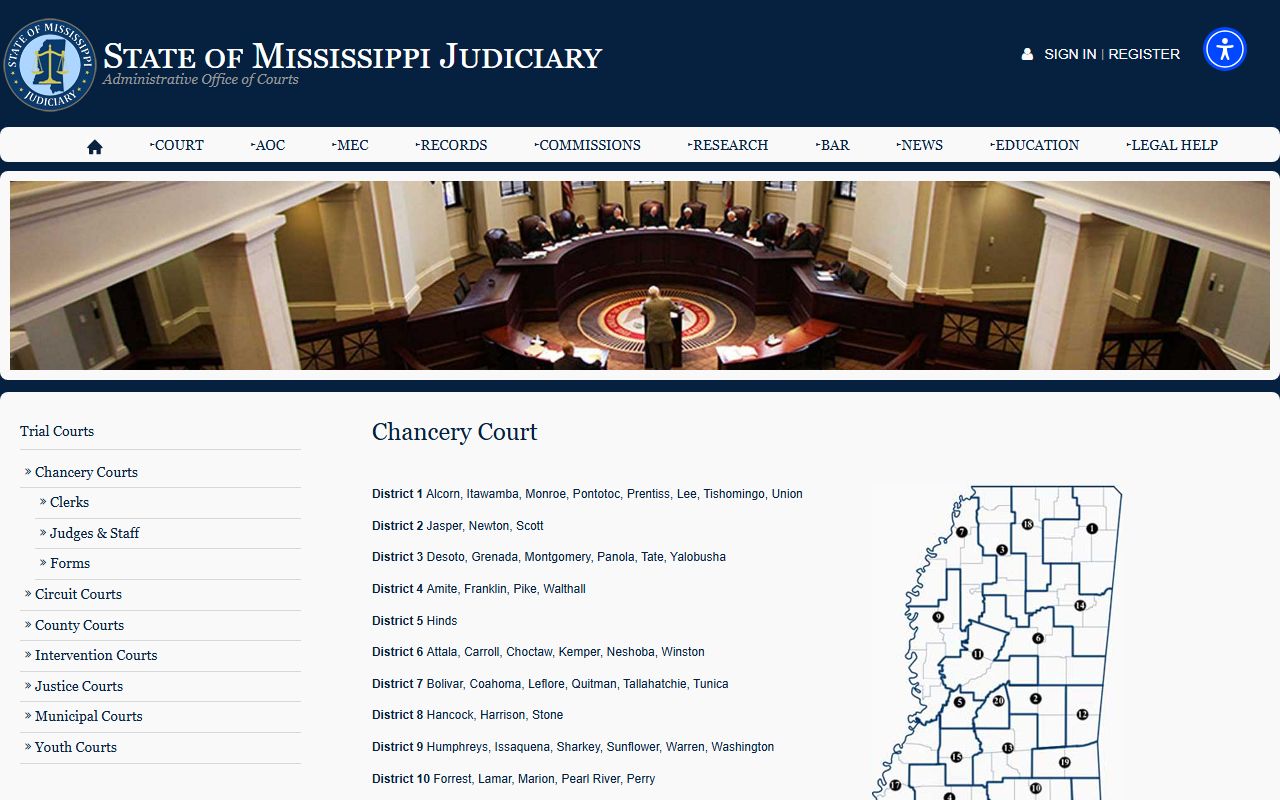
That overview explains why Clay County family and estate cases run on a Chancery docket rather than a general trial calendar. Probate, divorce, and guardianship all route through that court.
Clay County Court Terms and Schedule
Court dates follow set rhythms in Clay County. Circuit Court runs in terms rather than a daily calendar, and grand jury work falls inside two of those terms. The lower courts meet on fixed weekdays. The table below collects the published schedule for each court so a docket date can be matched to the right session.
| Court | When It Meets | Docket Contact |
|---|---|---|
| Circuit Court | Terms in January, April, July, and October | 662-494-3384 |
| Circuit Court Grand Jury | During the April and October terms | 662-494-3384 |
| Chancery Court | Set by the court; confirm by phone | 662-494-3124, ask for Vicki Ray |
| Youth Court | Most Wednesdays at 9:00 a.m. | 662-494-3124 |
| West Point Municipal Court | 1:00 p.m. Tuesdays; 9:00 a.m. second and fourth Fridays | 662-494-6386 |
| Justice Court | Set by the court; confirm by phone | 662-494-6140 |
Youth Court meets in the upstairs courtroom at 365 Court Street, and its 2026 dates are published through the county Youth Court page. Juvenile dockets are confidential, so the schedule is public even though the case details are not. The image below shows that official Youth Court page.
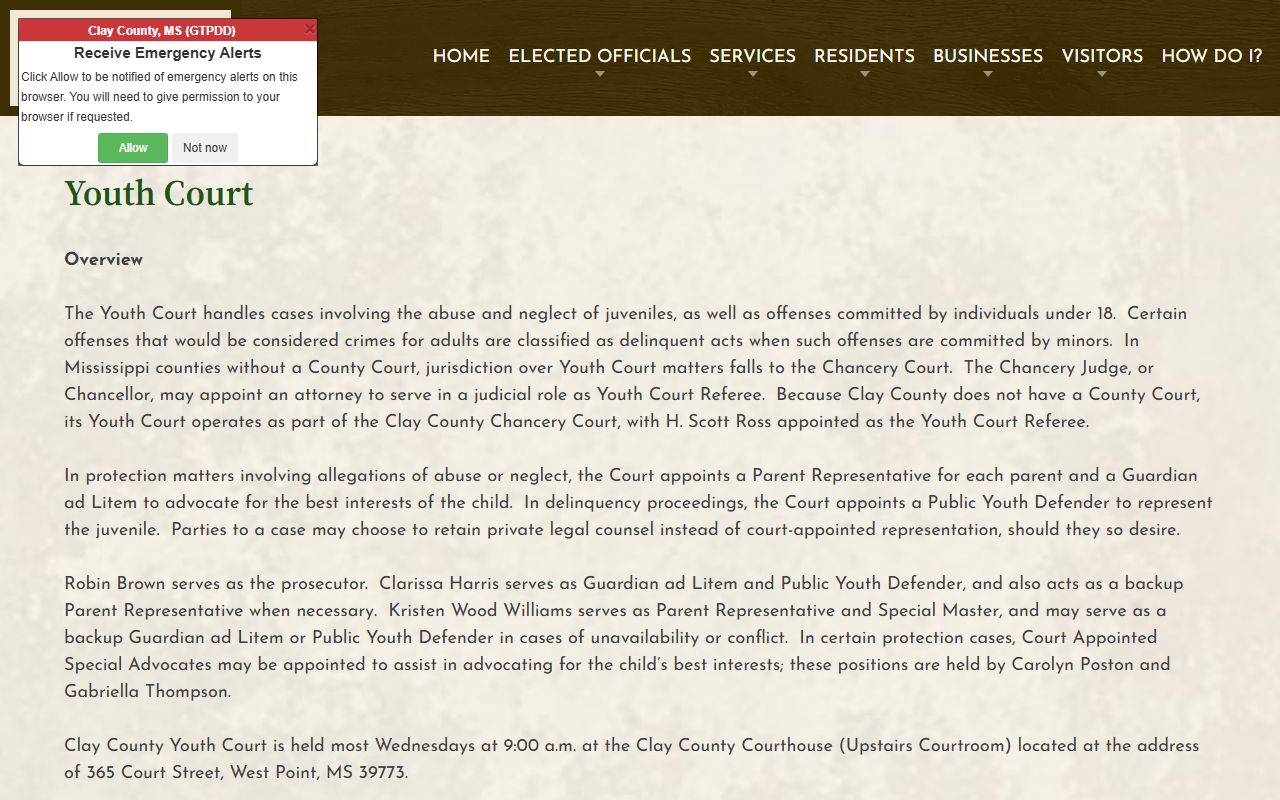
Because Clay County has no separate County Court, the Youth Court calendar operates through Chancery Court. A referee presides over the weekly juvenile docket. Circuit Court jurors who need to know whether a term is calling can use the jury call-in line at 662-391-1064 after 5:30 p.m. Pay is $25 per day, plus $0.40 per mile for jurors who live outside the city limits.
What a Clay County Docket Entry Shows
A single docket entry packs several pieces of information into one line. Reading those pieces makes the timeline clear. The fields below appear on a typical Circuit or Chancery docket entry maintained through the electronic system or the clerk's index.
| Field | What It Shows |
|---|---|
| Entry Date | The day the filing, hearing, or order was recorded on the case. |
| Event Type | What happened, such as a motion filed, an order entered, or a hearing set. |
| Party Filing | The plaintiff, petitioner, defendant, respondent, or attorney who acted. |
| Document Link | A link or reference to the actual paper held in the case file. |
The full case file ties these lines together. A Circuit Court file may hold the case number, charge or cause, indictment or complaint, bonds, subpoenas, orders, judgment entries, fines, and sentence. A Chancery file may hold pleadings, hearing dates, decrees, and estate or guardianship papers. The broader set of Clay County court records covers how those documents are requested and read.
Docket Versus Full Case Record
It helps to keep the two apart. The docket is the map of a case. The full record is the territory. One tells you what happened and when. The other holds the words, signatures, and exhibits behind each event. The comparison below sets them side by side.
| Docket | Full Case Record | |
|---|---|---|
| Format | List of dated entries | Full documents and exhibits |
| Access | Often online through the state system | May require a fee, login, or counter visit |
| Use | Track court dates and case progress | Legal review, evidence, certified copies |
| Where | Electronic system or clerk index | Clerk that owns the file |
For many needs the docket alone is enough. A party checking a hearing date, a reporter tracking a filing, or a relative confirming an order can stop there. A certified copy or a full document still means a request to the clerk, and some files are not online at all. Sealed cases, juvenile matters, adoption files, and mental-health records may not show on a public docket, or may appear with personal details removed.
Reading Clay County Docket Terms
Docket entries use legal shorthand. A few terms appear again and again across Clay County criminal, civil, and family cases. Knowing them turns a cryptic line into a clear event. The definitions below cover the words that show up most on local dockets.
- Docket
- A chronological list of events and filings in a case.
- Motion
- A written request asking the court to act.
- Order
- A written directive signed by a judge.
- Continuance
- A postponement of a hearing or trial to a later date.
- Disposition
- The final outcome, such as dismissed, guilty, not guilty, or judgment entered.
- Bench warrant
- A warrant a judge issues, often for failure to appear or comply.
Criminal dockets carry their own markers. An arraignment is the first appearance where charges are read and a plea is entered. A capias is a court-issued arrest order used after a failure to appear. An indictment is the grand jury charging paper, which is why grand jury terms in April and October matter for felony cases. The Clay County Circuit Court handles those felony dockets after indictment.
Before Visiting a Clay County Courtroom
A docket date often means a trip to the courthouse. Plan ahead so a hearing is not missed over a small detail. Court functions split across two West Point addresses. Chancery and Youth Court matters route to 365 Court Street, while Circuit Court records and jury functions route to the Court Complex on West Main Street. Confirm the destination before driving.
Justice Court enforces a strict dress code, and the rules cover items as much as clothing. The Clay County Justice Court page sets the contact and procedures for that court. The image below shows that official page.
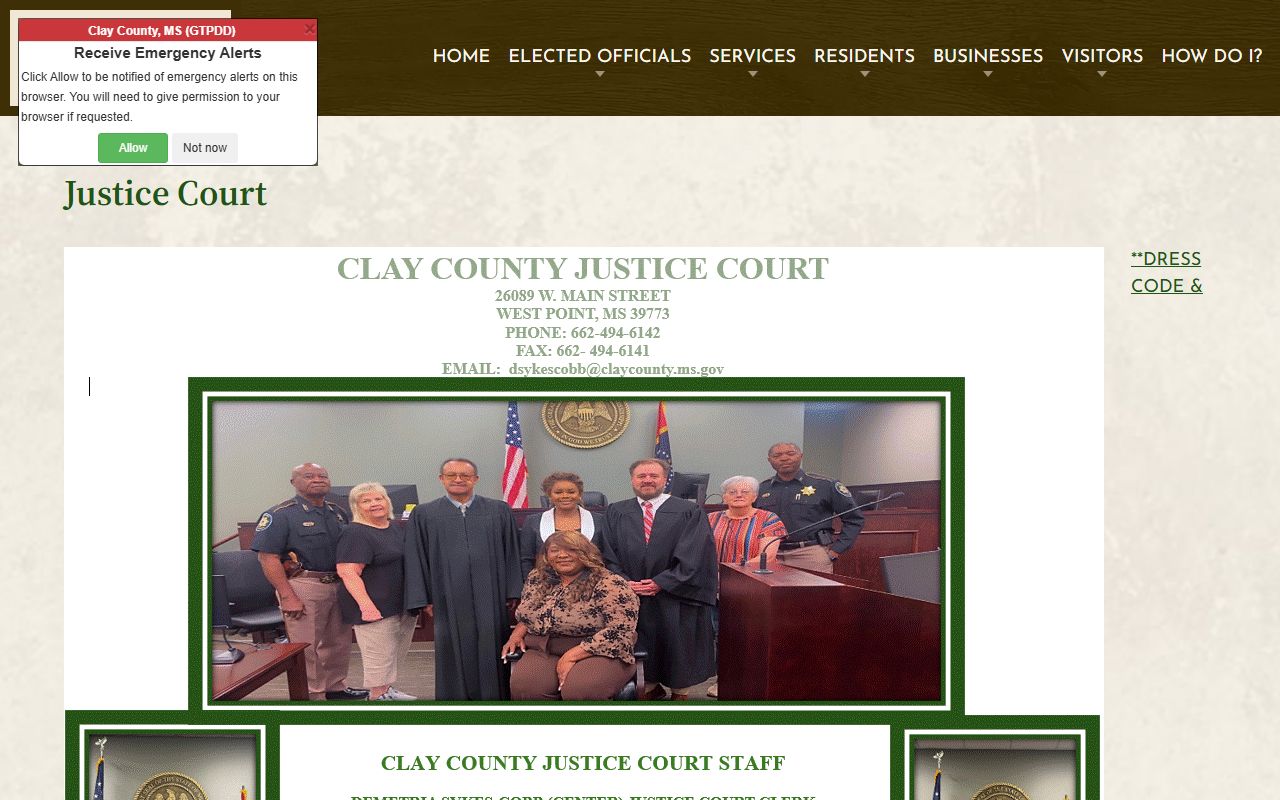
The posted rules bar purses, backpacks, and bags, along with shorts, tank tops, see-through clothing, hats, caps, and hair bonnets. Skirts or dresses above the knee, weapons, cellphones, pagers, other electronics, food, drinks, and saggy pants are also barred. People are turned away or delayed when they arrive with prohibited items, so travel light on a court date.
Important: Cellphones and other electronic devices are not allowed in the Justice Court courtroom, so leave them in the vehicle before a docketed appearance.